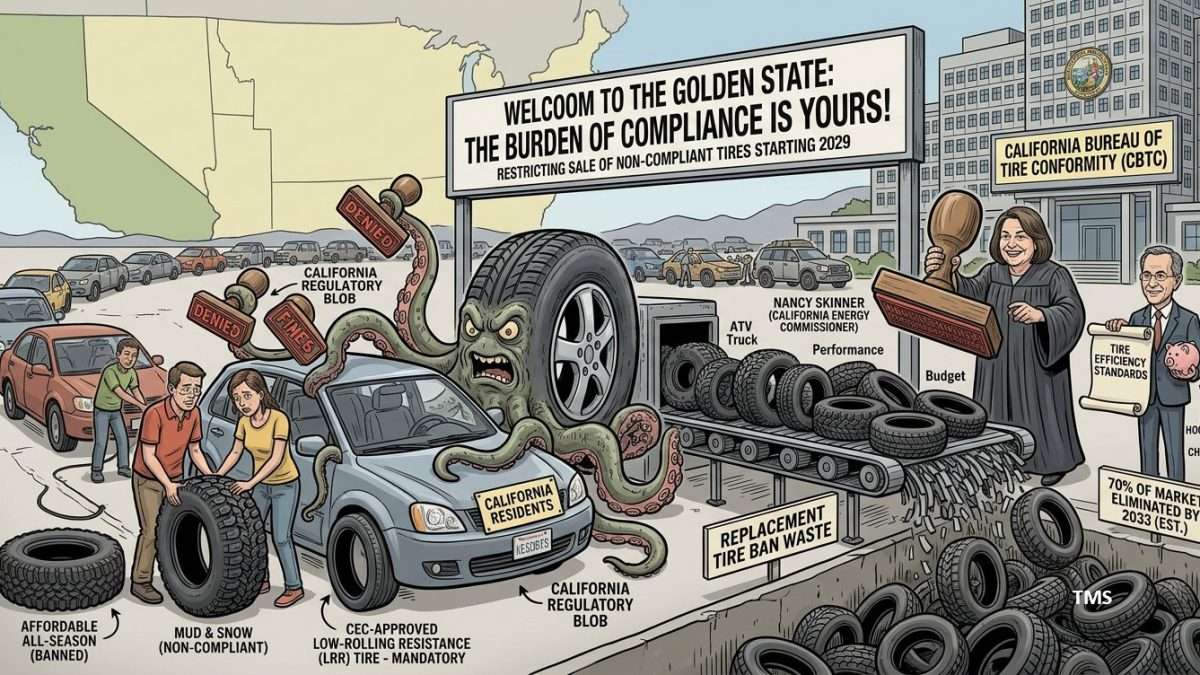
SACRAMENTO, Calif., Aug. 19 (Our California Times) — California drivers will face new limits on some replacement tires beginning in 2029 after the California Energy Commission unanimously approved statewide efficiency rules in August 2026.
The rules are designed to reduce the energy needed to move vehicles by regulating a tire characteristic known as rolling resistance. They apply to covered replacement tires offered for sale, not to the tires installed on a new vehicle when it leaves the factory.
The changes will affect drivers, tire retailers and manufacturers across California. The commission says the standards are intended to ensure that replacement tires are, on average, at least as energy-efficient as the original tires supplied with passenger cars and light-duty trucks.
How the standards work
Rolling resistance is the force that tires must overcome as they roll along the road. A tire with lower rolling resistance generally requires less energy to keep moving. For gasoline-powered vehicles, that can mean lower fuel use. For electric vehicles, it can mean lower electricity use.
The rules create two limits:
- Beginning in 2029, covered tires must meet a maximum rolling-resistance level of 9.1 newtons per kilonewton, or N/kN.
- Beginning in 2033, the limit drops to 7.2 N/kN.
The first phase is reported to apply to covered tires manufactured on or after Jan. 1, 2029. The California Energy Commission’s adopted standards and related explanations describe the rules as limits on replacement tires offered for sale. The treatment of tires already in inventory was not specified in the information available for this report.
CEC staff tested 537 types of tires while developing the standards. The commission projects that drivers could save $79 in energy costs over four months under the first phase and about $153 over seven months under the second phase. Those figures are projections from the commission, not guaranteed savings for every driver.
Which tires are covered?
The restrictions are aimed at common replacement tires for passenger vehicles and light-duty trucks. The rule includes exemptions for several specialized products, including competition tires; winter and some winter-performance all-season tires; used and retreaded tires; deep-tread tires; certain off-road and all-terrain vehicle tires; motorcycle tires; temporary-use and space-saver spare tires; and small tires with nominal rim diameters of 13 inches or less.
Other reported exemptions include limited-production tires, emergency-vehicle tires, high-load-index tires and tires that cannot sustain speeds above 50 mph.
The rule also includes wet-grip requirements intended to preserve traction and safety. The specific wet-grip thresholds were not included in the information available for this report.
The commission’s action does not mean that all replacement tires will disappear from California retailers in 2029. Instead, covered tires that do not meet the applicable rolling-resistance standard will be restricted. The list of available models is expected to become narrower as the stricter 2033 limit takes effect.
CEC-related estimates cited in reporting say that about 70% of tires currently sold in California could be excluded by 2033. The available information does not establish whether that estimate came from CEC staff, a commissioner or an industry source, so it should be treated as an estimate rather than a confirmed forecast.
Why California is making the change
The rules trace back to Assembly Bill 844, a 2003 California law that directed the Energy Commission to establish or explore tire-efficiency standards.
The commission says the goal is to reduce energy use while maintaining tire performance. Chairman David Hochschild described the policy as a way to protect consumers from higher costs over time, while Commissioner Nancy Skinner said the standards are meant to keep replacement tires comparable in quality and efficiency to the tires installed on new vehicles.
The commission has adopted the standards, but the changes are not yet operational. The first compliance date is in 2029, followed by the stricter threshold in 2033. The available material does not identify the final enforcement process, retailer obligations or how the state will handle noncompliant tires already held by sellers.
For California drivers, the immediate effect is limited: existing tires can continue to be used, and the rules do not require owners to replace tires before they are worn out. The main change will come when a driver shops for replacement tires after the new standards begin to apply.